
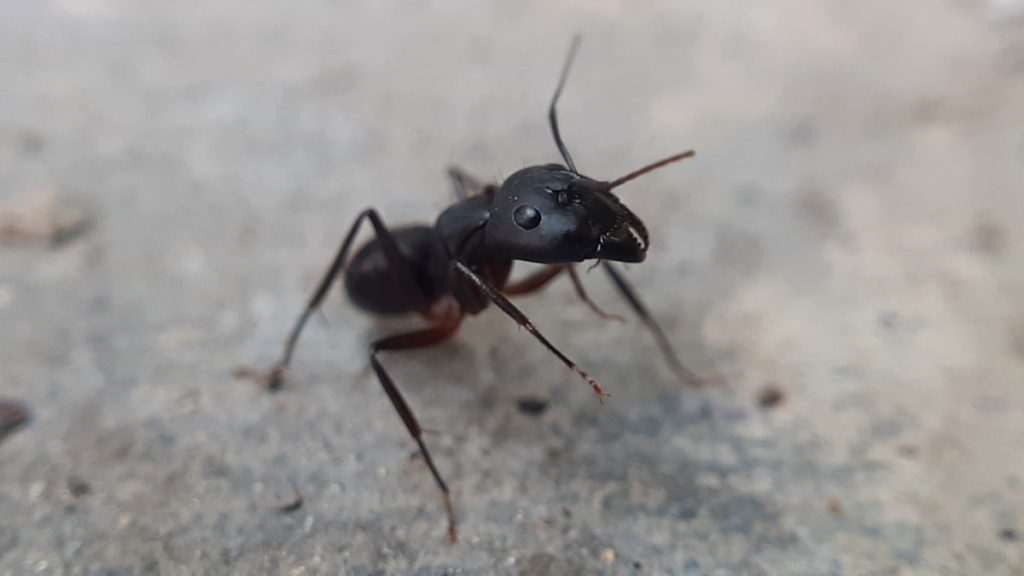
Are the large black ants in your home just annoying, or are they destroying your house from the inside out? In Michigan, this question matters more than you might think. Carpenter ants cause serious structural damage, while most other ant species are simply a nuisance. Knowing the difference can save you thousands of dollars in repairs.
Here’s how to tell carpenter ants from other black ants — and what to do about each.
Why Identification Matters
All ants can be a nuisance, but carpenter ants are genuinely destructive. They excavate wood to build their nests, creating smooth tunnels and galleries that weaken structural wood over time. Unlike termites, they don’t eat wood — they just hollow it out. The damage accumulates over years, and by the time homeowners notice, repairs can be expensive.
Other black ants — like pavement ants, odorous house ants, and little black ants — don’t damage wood. They’re annoying when they invade your kitchen, but they’re not compromising your home’s structure.
Physical Characteristics: How to Tell Them Apart
Carpenter Ants
Size: The most distinctive feature. Carpenter ants are large — workers range from ¼ to ½ inch long, and queens can be nearly an inch. If you’re seeing ants the size of your pinky nail, they might be carpenter ants.
Color: Usually black, but some carpenter ant species are reddish-brown or a combination. In Michigan, the black carpenter ant (Camponotus pennsylvanicus) is most common.
Body Shape:
- One prominent node (bump) between thorax and abdomen
- Smooth, evenly rounded thorax when viewed from the side
- Heart-shaped head
- Elbowed antennae with 12 segments
Wings: Reproductive carpenter ants (swarmers) have wings. The front wings are longer than the rear wings.
Common “Black Ants” (Non-Destructive Species)
Little Black Ants (Monomorium minimum)
- Tiny — only about 1/16 inch
- Jet black color
- Two nodes between thorax and abdomen
- Very commonly seen in Michigan homes
Pavement Ants (Tetramorium caespitum)
- About 1/8 inch long
- Dark brown to black
- Two nodes between thorax and abdomen
- Parallel grooves on head and thorax
- Commonly nest in cracks in pavement, foundations
Odorous House Ants (Tapinoma sessile)
- About 1/8 inch long
- Brown to black
- When crushed, emit a rotten coconut smell
- One flattened node (hard to see)
- Very common kitchen invader
Size Comparison
Carpenter ant: ¼ – ½ inch, One node, Structural damage
Pavement ant: ⅛ inch, Two nodes, Nuisance only
Little black ant: 1/16 inch, Two nodes, Nuisance only
Odorous house ant: ⅛ inch, One flat node, Nuisance only
The quick test: If the ant is bigger than a BB pellet, it might be a carpenter ant.
Behavioral Differences
Where You See Them
Carpenter Ants:
- Often seen traveling along consistent pathways at night
- Found in damp areas of the home — bathrooms, under sinks, around dishwashers
- May be spotted near woodwork, particularly where there’s moisture damage
- Frequently seen emerging from wall voids, window frames, or door frames
Other Black Ants:
- Usually found in kitchens following food sources
- Trail along counters, floors, and walls
- Enter through small cracks and gaps
- Often nest outdoors and forage inside
Activity Patterns
Carpenter ants are primarily nocturnal. If you’re seeing large black ants wandering around at 10 PM, that’s suspicious. Most other ant species are active throughout the day when foraging.
What They’re After
- Carpenter ants: Looking for protein and sugar, but also seeking moisture. They don’t eat wood — they excavate it for nesting.
- Other black ants: Primarily seeking food — sweets, grease, proteins, crumbs.
Evidence of Carpenter Ant Infestation
Even if you don’t see the ants themselves, carpenter ants leave evidence:
Sawdust-Like Frass
Carpenter ants push wood shavings out of their galleries. You might find small piles of fine, sawdust-like material (called frass) beneath window sills, near baseboards, or below wooden beams. Carpenter ant frass often contains insect parts since they keep their galleries clean.
Rustling Sounds
Large carpenter ant colonies in wall voids can sometimes be heard. Press your ear to a wall you suspect is infested — you may hear faint rustling or crinkling sounds as ants move through galleries.
Damaged Wood
Wood damaged by carpenter ants has smooth, clean galleries (unlike termite damage, which has mud-packed, rough tunnels). The galleries follow the wood grain and are kept immaculately clean.
Winged Swarmers
In spring (March through June in Michigan), mature carpenter ant colonies release winged reproductives. Finding large winged ants indoors, especially emerging from walls or ceilings, strongly suggests an established colony in your home.
What Attracts Carpenter Ants to Your Home?
Understanding what draws carpenter ants helps with both identification and prevention:
- Moisture damage: Carpenter ants strongly prefer damp or decaying wood. Leaks, condensation, and poor drainage create ideal conditions.
- Wood-to-soil contact: Wood touching the ground provides easy access.
- Trees and shrubs touching the house: Carpenter ants often establish satellite colonies in homes after nesting in nearby trees.
- Stacked firewood: Keeping firewood against your house is an invitation.
- Previous water damage: Even wood that has dried out may retain enough damage to attract carpenter ants.
What to Do If You Have Carpenter Ants
If you’ve identified carpenter ants in your home, take action:
Don’t just spray them. Surface sprays might kill the ants you see, but they won’t eliminate the colony — and that colony is likely inside your walls. You may actually make things worse by causing the colony to split and spread.
Find the source. Try to track where ants are coming from. This helps locate the nest.
Address moisture problems. Whatever water issue attracted them needs to be fixed, or they’ll return.
Call a professional. Carpenter ant elimination requires locating and treating the main colony, which often means treating wall voids, attics, and other hidden areas. Professional treatment is significantly more effective than DIY methods.
What to Do About Other Black Ants
For nuisance ants that aren’t carpenter ants:
- Keep food sealed and clean up crumbs and spills
- Seal entry points where ants are entering
- Remove attractive food sources
- Consider ant baits, which can be effective for small invasions
- For persistent problems, professional treatment may be warranted
When to Call a Professional
Call a pest control professional if you see:
- Large black ants (¼ inch or bigger) inside your home
- Winged ants emerging from walls or ceilings
- Sawdust-like material near woodwork
- Signs of moisture damage plus ant activity
- Ant problems that don’t respond to over-the-counter treatments
If you’re dealing with ants in the Metro Detroit area, call (734) 590-4035 for help. We serve Livonia and surrounding communities from 38221 Plymouth Rd Suite 1, Livonia, MI 48150. We’ll identify exactly what you’re dealing with and recommend the right solution.
Don’t guess when it comes to carpenter ants — proper identification is the first step toward protecting your home.